Announcement

Collapse
No announcement yet.

Goldi is on insulin - question about dose

Collapse
X
 
  • Filter
  • Time
  • Show
Clear All
new posts

  • Goldi is on insulin - question about dose

    Has anyone used a 'by mouth' med to treat canine diabetes? My vet prescribed glipizide/glucotrol for my 13 year old toy poodle because I couldn't make myself administer insulin via syringe. I give it to her twice a day by mouth using a dropper.

    Are there any other methods to be used? I feel like such a failure because the couple of times I tried giving her a shot, my hands shook & she screamed so I said that I just can't do it. Surely, I can't be the only person who reacted this way. What do other pet owners do?

    Any ideas or help would be appreciated.
  • #2
    Re: Alternative to injections?

    Dogs have type 1, or insulin-dependent diabetes. This means the beta cells of their pancreases are unable to produce either any or enough insulin for their bodily needs.

    Glipizide is a drug which increases the action of the pancreatic beta cells:

    http://www.veterinarypartner.com/Con...=627&SourceID=

    "Glipizide acts by increasing the pancreas' secretion of insulin and it is possible that a level of adequate control can be achieved by maximizing the pancreas' secretion in this way."

    The beta cells in canine diabetes are beyond being able to be stimulated to produce insulin. This is why canine diabetes means insulin shots.

    "Oral Agents in Dogs

    "The canine diabetes mellitus experience is more readily compared to Type I (insulin dependent) diabetes in humans. Drugs that are often helpful for feline diabetics have been crashing failures in dogs when used alone; however, some agents can be used as adjuncts to assist the insulin in achieving normal blood sugar levels.

    "ACARBOSE (GLUCOBAYŽ, PRECOSEŽ)

    "This medication inhibits the digestive enzymes responsible for breaking down starches. It's use leads to a more gradual absorption of sugars after a meal which in turn leads to a more stable blood sugar level. This medication is expensive and has potential for side effects (flatulence, weight loss, and diarrhea) thus it is not used except in dogs that have been difficult to control with insulin alone."

    The reason an oral drug might help feline diabetes is because their diabetes is much like type 2, or non-insulin-dependent diabetes in people. People with type 2 can keep theirs in control in a variety of ways: some with diet alone, some with diet and oral meds; some are now using meal time insulin (short or rapid acting insulin used before or at meals).

    Someone with type 1, or insulin-dependent diabetes has a deficiency of insulin and the only way to correct that deficiency is by giving insulin injections. Using an oral med to try to get beta cells that are not able to be stimulated into producing insulin again is something like trying to get your car to run when there's no gas in the tank--the only answer is to get more gas and put it in.

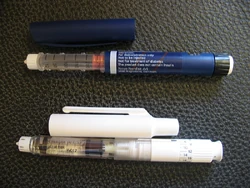
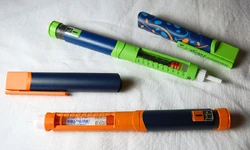
    If you can tell us what aspect of giving insulin shots frightens you, we can probably suggest a workaround. There are insulin pens like these; some are disposable and others are refillable, like an ink pen with cartridges:


    There's also a device called Inject-Ease which takes the anxiety out of giving a shot:

    http://www.palcolabs.com/section_pro...njectease.html


    She's probably picking up on your anxiety the times you did try to give her shots. You can learn how to give a pain-free shot in confidence.

    http://k9diabetes.com/forum/showthread.php?t=973

    http://k9diabetes.com/forum/showthread.php?t=1002

    http://k9diabetes.com/forum/showthre...light=princess

    Above are links to threads about shot time problems we have here on the Forum. The thread about Princess would be of interest, I think, because Princess and Natalie had quite a time in the beginning. With work, both Natalie and Princess were able to get to the point where injection time wasn't time for trauma and tears for either of them.

    Many people have difficulty with this in the beginning--none of us really wanted to give our dogs shots but we realized that we had to do this to control their diabetes.

    Please tell us more so we can try to help!

    Kathy

    Comment


    • #3
      Re: Alternative to injections?

      I remember reading about someone (can't remember who) that called a doggie daycare/boarding center and set up an arrangement to administer the shots. She paid a small fee at first but eventually became confident enough to do it herself. A pet sitter with experience might be another idea as they could come to the house at shot time.

      Just thinking outside the box...it might allow you to observe someone enough to feel comfortable trying again.

      Hopefully the tips from other threads will help!
      Patty
      Patty and Ali 13.5yrs 47lbs diagnosed May '08 Ali earned her wings October 27, 2012, 4 months after diagnosis of a meningioma ~ Time is precious ~

      Comment


      • #4
        Re: Alternative to injections?

        I know you're replying right now... it occurred to me that I know someone who had a diabetic dog who lives in the same city that you do and who might be able to help you. I don't know where exactly, of course... how close to you she might be to you geographically. But I suspect she'd be very willing to try to help you.

        Natalie

        Comment


        • #5
          Re: Alternative to injections?

          Originally posted by k9diabetes View Post
          I know you're replying right now... it occurred to me that I know someone who had a diabetic dog who lives in the same city that you do and who might be able to help you. I don't know where exactly, of course... how close to you she might be to you geographically. But I suspect she'd be very willing to try to help you.

          Natalie
          Hi again Natalie,

          How do you put people in touch with each other? I have no problem giving you my contact info, if you want.

          Eileen

          Comment


          • #6
            Re: Alternative to injections?

            Originally posted by Patty View Post
            I remember reading about someone (can't remember who) that called a doggie daycare/boarding center and set up an arrangement to administer the shots. She paid a small fee at first but eventually became confident enough to do it herself. A pet sitter with experience might be another idea as they could come to the house at shot time.

            Just thinking outside the box...it might allow you to observe someone enough to feel comfortable trying again.

            Hopefully the tips from other threads will help!
            Patty
            Hi Patty,
            What a great idea. There is a kennel about a mile away in which I left Goldi last May while I went to Kansas for a nephew's graduation. And, of course, they had to administer the shot every day. I might be able to go there because it's closer than the vets. I could watch them do it a few times before I do. I know the needle is so tiny and that she doesn't feel it. She definitely was reacting to my shaking hands and tenseness and that's why she screamed..........but, boy! it upset me so.

            Thanks very much for your help. Forums/chat rooms are new to me. Except for using a Microsoft one many months ago when I was having pc problems, this is my first venture of this kind and I like it, I like it!!

            Eileen

            Comment


            • #7
              Re: Alternative to injections?

              Originally posted by We Hope View Post
              Dogs have type 1, or insulin-dependent diabetes. This means the beta cells of their pancreases are unable to produce either any or enough insulin for their bodily needs.

              Glipizide is a drug which increases the action of the pancreatic beta cells:

              http://www.veterinarypartner.com/Con...=627&SourceID=

              "Glipizide acts by increasing the pancreas' secretion of insulin and it is possible that a level of adequate control can be achieved by maximizing the pancreas' secretion in this way."

              The beta cells in canine diabetes are beyond being able to be stimulated to produce insulin. This is why canine diabetes means insulin shots.

              "Oral Agents in Dogs

              "The canine diabetes mellitus experience is more readily compared to Type I (insulin dependent) diabetes in humans. Drugs that are often helpful for feline diabetics have been crashing failures in dogs when used alone; however, some agents can be used as adjuncts to assist the insulin in achieving normal blood sugar levels.

              "ACARBOSE (GLUCOBAYŽ, PRECOSEŽ)

              "This medication inhibits the digestive enzymes responsible for breaking down starches. It's use leads to a more gradual absorption of sugars after a meal which in turn leads to a more stable blood sugar level. This medication is expensive and has potential for side effects (flatulence, weight loss, and diarrhea) thus it is not used except in dogs that have been difficult to control with insulin alone."

              The reason an oral drug might help feline diabetes is because their diabetes is much like type 2, or non-insulin-dependent diabetes in people. People with type 2 can keep theirs in control in a variety of ways: some with diet alone, some with diet and oral meds; some are now using meal time insulin (short or rapid acting insulin used before or at meals).

              Someone with type 1, or insulin-dependent diabetes has a deficiency of insulin and the only way to correct that deficiency is by giving insulin injections. Using an oral med to try to get beta cells that are not able to be stimulated into producing insulin again is something like trying to get your car to run when there's no gas in the tank--the only answer is to get more gas and put it in.

              If you can tell us what aspect of giving insulin shots frightens you, we can probably suggest a workaround. There are insulin pens like these; some are disposable and others are refillable, like an ink pen with cartridges:


              There's also a device called Inject-Ease which takes the anxiety out of giving a shot:

              http://www.palcolabs.com/section_pro...njectease.html


              She's probably picking up on your anxiety the times you did try to give her shots. You can learn how to give a pain-free shot in confidence.

              http://k9diabetes.com/forum/showthread.php?t=973

              http://k9diabetes.com/forum/showthread.php?t=1002

              http://k9diabetes.com/forum/showthre...light=princess

              Above are links to threads about shot time problems we have here on the Forum. The thread about Princess would be of interest, I think, because Princess and Natalie had quite a time in the beginning. With work, both Natalie and Princess were able to get to the point where injection time wasn't time for trauma and tears for either of them.

              Many people have difficulty with this in the beginning--none of us really wanted to give our dogs shots but we realized that we had to do this to control their diabetes.

              Please tell us more so we can try to help!

              Kathy
              Hi Kathy,
              Thanks for your reply. You know so much! I'm going to print it out and start a folder to keep all the info close..........I have so much to learn. I won't have time tonight to visit the links you gave me about giving a pain-free shot.......it'll have to wait until tomorrow. I'm playing cards this evening with some 'girlfriends'. We are all in our 60's & 70's but we're still 'girlfriends'.........ha, ha!

              Comment


              • #8
                Re: Alternative to injections?

                It's me again, Kathy. I just reread the info in your note & see that the first part is a quote from We Hope[/I]............so, thank you We Hope!

                And thank you again Kathy!

                Eileen

                Comment


                • #9
                  Re: Alternative to injections?

                  This is to all you wonderful people who reached out to me this evening. I'm so grateful. Before hearing from you, I was feeling quite alone and worried. I'm going to sign off for now but I'll be back tomorrow or later tonight after my company leaves.

                  Eileen

                  Comment


                  • #10
                    Re: Alternative to injections?

                    Eileen,

                    I'm glad you came here to investigate. Besides the links given to you already, quite a few people have reported this one really helpful.

                    http://www.coherentdog.org/vek/painlessinj.php

                    My diabetic dog Kumbi, along with my vets, were my teachers for this, and Natalie and Kathy contributed the tip about keeping the bevel of the needle up.. Looking forward to your further reports!

                    Sat, 19 Sep 2009 20:01:34 (PDT)
                    http://www.coherentdog.org/
                    CarolW

                    Comment


                    • #11
                      Re: Alternative to injections?

                      I understand the dog is good with shots at the vet so I think it's mainly a matter of getting Eileen over her fear. Which is great as it would be much more difficult if the dog was scared of all shots.

                      When I think about my cat and that first insulin shot... if she had let out a scream in response, I probably would have screamed back and never tried again! Or just plain had a heart attack as I was such a wreck already.

                      I will email the folks I know and see if they are interested and have time to help.

                      Natalie

                      Comment


                      • #12
                        Re: Alternative to injections?

                        After you do it a couple times it will be a piece of cake. Try poking an orange a few times (use water not the expensive insulin) Just to get the feel of how a syringe works.

                        I don't know if any inulins that are appropriate for you dog can be used in one, but there is a needleless device for humans that can't handle injections. It uses high pressure to drive the insulin into the skin. It it pretty loud, but we give certain cat vaccines with one & they seem to do OK with it.

                        BUT really the injections don't hurt (I have to stick myself 4-6 times a day & most of the time I can't feel it!)

                        It will help to draw the insuling then hold the syringe in your hands a minute to take the chill off--cold insulin does sometimes sting a bit

                        Also, not sure how your vet taught you but I found this advice very easy to picture in my head when i was first taught how to do Sub Q injections: pull some skin up to make a "tent" with your non-dominant hand, poke the "door" to the tent with your fore finger of the other hand and that's where you are going to put the needle. Insert the needle into the "door" at a bit of an angle so it isn't directly sideways or directly up & down.

                        I hope you are able to find someone to help you out; maybe your vet will do it for you.
                        --Sonya
                        www.cornspot.com

                        Comment


                        • #13
                          Goldi is on insulin - questions about dose, Vetsulin

                          Posted November 13, 2009 and merged to EileenRC's thread November 14 by Natalie

                          Today my 14 year old toy poodle, Goldi, resumed insulin injections. I had been giving them to her daily until July 22nd when I decided that I didn't want to do it anymore (I just hated doing it.) and asked my vet to prescribe an oral medicine.......glipizide. I guess I never felt good about the switch because I never read anything positive about this medication. Also, every source I read or searched that prescribed insulin injections also commented that there were no good oral meds at this time for dogs. So, I've decided that I have no choice but to suck it up and do what's best for Goldi. My question........is it possible for the insulin need to lessen from 6 units to 3 units?

                          EileenRC

                          Here's the rest of Eileen's post. I may rearrange this so it shows up under her name but wanted to post this for now...

                          More on Goldi's situation/prescription.......she is to receive the 3 units once a day. The former dosage of 6 units was also once a day. I've read that many people have to give it twice a day, so I wonder about that too.

                          My next concern is with dismissive attitude of my vet when I asked him about not using Vetsulin because of an FDA report questioning its efficacy. He used Vetsulin today and that's what I have here at home to give Goldi tomorrow...........am I right to be concerned or am I over reacting? I think that's all for now.........hope it's not too much to post.

                          Comment


                          • #14
                            Re: Goldi is on insulin - question about dose

                            Hi Eileen,
                            I'm sure there are others that will come along to help but I wanted to say I'm glad you decided to "suck it up" as you say and go back to injections.

                            I do know that Glipizide or Glucotrol blocks the potassium channels in the beta cells of the pancreas, which in turns increases the amount of calcium and signals the release of more insulin from the beta cells. This is helpful for Type II diabetics that can produce their own insulin but have develop resistance. I know Kathy had sited some info like this.

                            But Type I diabetics, like dogs, don't produce insulin anymore. The beta cells are destroyed so the Glipizide can't help them produce what isn't there.

                            As far as the dose of insulin, that depends on the food you are feeding now and how the body is using the insulin.

                            I recently switched insulins and had to return to NPH. Ali is now using a full 1-2 units less so far than she had previously.

                            What dose did you start out with?
                            What type of insulin?
                            Are you feeding the same food as before July 22nd?
                            Is she still 9lbs?

                            Hang in there
                            Patty
                            Patty and Ali 13.5yrs 47lbs diagnosed May '08 Ali earned her wings October 27, 2012, 4 months after diagnosis of a meningioma ~ Time is precious ~

                            Comment


                            • #15
                              Re: Goldi is on insulin - question about dose

                              Are you monitoring her blood sugar - am wondering how the single injection per day has been containing her blood sugar. Anything you can tell us about that would be helpful.

                              My best guess about the Vetsulin is that the supply IS going to be depleted and it's only a question of when that occurs and how long it is not available.

                              So you may very well have to switch to NPH... but NPH absolutely must be given twice a day.

                              It may be that, given that you have struggled with giving injections, the vet is wanting to stick with an insulin that "sometimes" works once a day. In truth, it almost never works properly when given once a day...

                              So if you can tell us more about how her blood sugar has been on 6 units and on 3 once a day, we can talk more about what is and isn't working.

                              Natalie

                              Comment

                              Working...
                              X