Announcement

Collapse
No announcement yet.

Baby Girl Passed on 2/27/16

Collapse
X
 
  • Filter
  • Time
  • Show
Clear All
new posts

  • Re: Lab Lover

    Hi Ida,

    I assume when you say glucose toxicity you're talking about some resistance to the effect of the insulin that can occur after a dog (or person) has had high blood sugar for a while?

    I'll be honest... I haven't paid much attention to the chemical processes behind it. I believe the insulin is absorbed properly but the body doesn't respond very well to it.

    Just know that the worse your blood sugar is, the worse your response to insulin can be. So after you give your dog enough insulin to bring the blood sugar down into a good range, that resistance or lack of response to the insulin goes away and suddenly the 8 units that was perfect last week is now too much insulin and the dog settles down into needing only 7 units once that lack of sensitivity to the insuling is gone.

    Also, tonight when I gave her the shot I noticed just the tip of the needle was entered in her skin, and the rest of needle was out -there was no leakage
    You want to get the insulin under the skin... if you inject too shallow, you will inject into the skin rather than under it and that may affect how the insulin gets absorbed and used. Maybe alter your technique a bit and see if you can more consistently get the needle under the skin.

    How much carborhydrates should she be eating
    The push with dog foods is to go more protein and less grain so the feed store person is probably approaching it from that angle. With a diabetic dog, I say feed what works with the insulin. Some dogs really need some carbs to go with a strong insulin action.

    If what you're feeding Baby is working for her, then I wouldn't change it.

    None of us can say how much carbs Baby needs - only her body and her response to the food and insulin together can tell you if the balance is right.

    Chris went to a dog food with far less grain but also went from canned food to dry food at the same time and he got a big spike of blood sugar after eating from the canned food that was lower in carbs!

    Natalie
    Comment


    • Re: Lab Lover

      Hi Natalie

      I think now some of Baby's high's and low's could be the way I am injecting her and never realized I might be doing it wrong until this morning. When I went to inject her I noticed the needle went all down into the skin and not like the other times where I just saw the tip go in. I printed up a couple pages on the forum where you show how to inject with the bevel side up. Because of not seeing good yet it is hard for me to see the bevel side - and when I inject her I try to hold the skin up and give the shot at a angle but, sometimes with her skiin so thick and the fatty part near the neck it is hard. I think it is called the flank (by the side of neck) she flinches a lot and I feel I am hurting her so I give it too her mostly in her fatty part on each side of her neck.

      I am using the 29 gauge needle U-100, I just want to know should the needle be all the way in the skin or should you see some of it after you inject her. I think now that is how she was so low near dinner and other times because the insulin is not being absorbed right. Is it harder for insulin too work if your giving it in the fatty area around the neck. Will watch closely tonight. I did print out the picture of the needle will keep it in front of me tonight and try to see if I am doing it right. When we go to the vet next month I am going too show him How I do it but, can't get her too him till July. Ida
      Last edited by lab lover; 06-18-2009, 12:51 PM. Reason: When you say under skin do you mean lifting her skin and injecting at a angle but, the lower part closer to her body?

      Comment


      • Re: Lab Lover

        Hi Ida,

        When dx Niki got her injections in her scruff anywhere from the middle to the sides of the scruff area, she usually never flinched, I picked up her scruff area, made the tent and injected at a slight downward angle at top of tent, never thru the tent, I could feel the needle as it went thru the skin with no resistance and then injected. I think Baby would flinch if you hit a muscle as they do at times when they get a rabies shot or she may have flinched if needle went into skin area, let me find some pics or if I remember tonight I will get my mum to take the picture of my injection. Ok was able to save the picture from the BD link.
        Its done the same way at top of scruff area, see how the needle is going in at an angle.

        Hope this helps,
        Dolly


        Last edited by eyelostit; 06-18-2009, 05:25 PM. Reason: Right picture added
        Dolly & Niki passed 2010, 45 lb Border Collie Mix 8 yrs as diabetic, 13yrs old. Blind N 10.5 U 2 X * Dog is God spelled backwards*If there are no dogs in Heaven then when I die I want to go where they went. Niki's food Orijen & Turkey & Gr. Beans, See you at the bridge my beloved & cherished Niki, I miss you everyday

        Comment


        • Re: Lab Lover

          Ida,

          One thing for sure is you didn't hit a muscle. When insulin is injected into a muscle, it works much faster than it does when you inject it under the skin:

          http://petdiabetes.wikia.com/wiki/IM

          "Intramuscular insulin injection is a technique used for both pets and people in an effort to hasten onset, compared to the usual technique of injecting subcutaneously. It's often referred to medically by the abbreviation IM.

          "Because it carries with it a substantial risk of hypoglycemia, giving insulin intramuscularly should only be done with guidance from a medical professional."

          http://www.bd.com/us/diabetes/page.a...t=7001&id=7395


          There are other areas you can inject besides the scruff:

          "Some veterinarians feel that the scruff is not the best place to inject because this area is prone to the formation of lumps under the skin, and because it is easier for the owner to mistakenly inject into muscle or skin. Any of these would interfere with proper insulin absorption. Other veterinarians feel that the scruff is acceptable as an injection site if the owner uses proper injection technique.

          "Whichever injection sites you use, the key is to use proper pinch-up technique so that the needle goes into the fat layer below the skin - not into skin or muscle, and not through the pinch and out the other side, which just squirts insulin onto the pet's fur instead of into the pet.

          "It is important to rotate injection sites, because constant use of the same spot will cause scarring, which will affect how well the insulin is absorbed."

          Another reason some don't prefer using the scruff is because of the absorption from the area:

          http://web.archive.org/web/200702081..._diabetes.html

          Dr. Greco:

          "Is the client rotating sites?

          "Is the client injecting in the proper place? (Armpit or flank instead of in the scruff; the scruff is a poorly vascularized area with slow absorption.)"

          When we went to Caninsulin/Vetsulin, I switched over to the Intervet suggested areas for shots:

          http://www.vetsulin.com/vet/DosingOverview.aspx

          "Using a U-40 insulin syringe, administer the injection subcutaneously, 2 to 5 cm (3/4 to 2 in) from the dorsal midline [spine], varying from behind the scapulae [shoulder blades] to the mid-lumbar [back] region and alternating sides."

          In the morning, I would give Lucky's shot on one side, and in the evening on the other. I'd also vary the injection site by working my way up and down the areas above. This made sure I wasn't giving the shots in the same place all the time.

          Because Lucky wouldn't let me either do a pinch or tent on his skin, my answer about whether I could see the needle would be different.


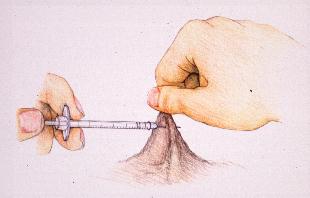
          Correct way to give an injection when "tenting" the skin. This makes sure the insulin is injected into the skin flap created by "tenting" it. When the skin "tent" is released, the injected insulin is under it, or subcutaneous.

          Does this picture help?

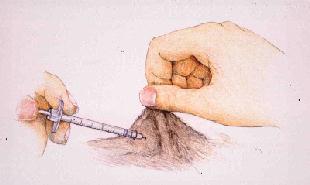
          The next picture is the wrong way to give a shot:


          Wrong way to give a shot: The needle has totally passed through the "tented skin". The insulin, or any other injected drug, will be injected into the air. Note that in this graphic, the injection point is much closer to the "pinch" area holding the "tent" up. In the correct graphic, the injection point is closer to the body.

          HTH!

          Kathy

          Comment


          • Injecting insulin

            Kathy, Dolly,


            I just read everything on injecting, pulling up the skin like a tent also went over to the website and went over everything. Sometimes I think I am doing it right but, sometimes her skin is so thick when I pulled it up and squeeze it - it is hard for me too hold it right (this is in the scruff area around the neck) When I try by her side she doesn't have a lot and flinches. Hopefully I will get this right. Don't know why this is bothering I guess because I couldn't get it in one time but, if I was doing wrong every time she wouldn't have good levels from time to time she would run high or low everyday -right? I trie dprinting out the picture showing the person holding the skin up but, it would go back to the beginning of the website if anyone has a pic pls send by email than I can print them and keep it in front of me when I inject her - I'm the type of person I liked too look at what I am doing when I am doing it. Sounds stupid I guess but, poor memory or old age - who knows. Thanks for helping everyone. Ida

            Comment


            • Re: Lab Lover

              Ida,

              Three of them on their way to you by email!

              Kathy

              Comment


              • Baby's vaccines since being diagnosed

                Next week Baby will be going for her first vaccines since being diagnosed is there anything I should know or asked the vet before she gets her shots. Also, what blood test should be done on her - the other vet I started with would do a chemistry profile when she was diagnosed in Jan is this all she needs. I noticed Dolly, posted something about a titers test - I am not familar with this test and should Baby have it done. I just don't want too spend money on test that is not needed.

                What about urine if I can collect it what should they test it for just glucose or a complete urine test. We are not going till next wk any info would be appreciated.

                She has been going high in the am and pm and has loss 4 more pounds so I am anxious for the vet too checked her out. This morning I injected wrong again and she stayed in the 300's all day. I still have hardly any vision in my eye from surgery in April so I have to really be careful when I inject her. I felt bad all day I knew that was the reason she only dropped 50 points the whole day so the insulin was never absorbed - can't wait till I can see normal again. Take care, everyone and thanks again for all your help. Ida

                Comment


                • Re: Baby's vaccines since being diagnosed

                  Originally posted by lab lover View Post
                  Next week Baby will be going for her first vaccines since being diagnosed is there anything I should know or asked the vet before she gets her shots. Also, what blood test should be done on her - the other vet I started with would do a chemistry profile when she was diagnosed in Jan is this all she needs. I noticed Dolly, posted something about a titers test - I am not familar with this test and should Baby have it done. I just don't want too spend money on test that is not needed.

                  What about urine if I can collect it what should they test it for just glucose or a complete urine test. We are not going till next wk any info would be appreciated.

                  She has been going high in the am and pm and has loss 4 more pounds so I am anxious for the vet too checked her out. This morning I injected wrong again and she stayed in the 300's all day. I still have hardly any vision in my eye from surgery in April so I have to really be careful when I inject her. I felt bad all day I knew that was the reason she only dropped 50 points the whole day so the insulin was never absorbed - can't wait till I can see normal again. Take care, everyone and thanks again for all your help. Ida

                  Sounds like my day, I didn't think I injected wrong (but how do you know I guess)..... 300's all day for me too (the last couple of days have been decent but today was horrible).... interesting we had similar days and I have never heard of these tests but will be waiting to see what others say (as I haven't had to take my dog in since being diagnosed for any shots or anything yet)...

                  Comment


                  • Re: Baby's vaccines since being diagnosed

                    I'm with you on the titer tests. I'd like to know if the dogs REALLY need the injections every year. I don't want to administer more drugs unnecessarily.
                    My little dog - a heartbeat at my feet. ~Edith Wharton

                    Comment


                    • Re: Baby's vaccines since being diagnosed

                      Hi Ida!

                      What Dolly is talking about would be done instead of vaccinating:

                      http://www.caberfeidh.com/CanineTiters.htm

                      "A "titer" is a measurement of how much antibody to a certain virus (or other antigen) is circulating in the blood at that moment.

                      "Titer testing is usually done in dogs for the most common and deadly canine viruses, parvovirus (CPV) and distemper (CDV). Rabies titer testing is also done, usually for purposes of travel to foreign countries that require it."

                      http://www.canine-epilepsy-guardian-...titer_test.htm

                      "Fortunately, there is a tool that veterinarians and dog owners can use to determine whether or not a dog really needs further vaccination at any given time. It’s called a “titer test,” and it’s readily available, not terribly expensive, and offers multiple advantages over the practices (intentional or not) of over-vaccination and under-vaccination.

                      "The term “titer” refers to the strength or concentration of a substance in a solution. When testing vaccine titers in dogs, a veterinarian takes a blood sample from a dog and has the blood tested for the presence and strength of the dog’s immunological response to a viral disease. If the dog demonstrates satisfactory levels of vaccine titers, the dog is considered sufficiently immune to the disease, or possessing good “immunologic memory,” and not in need of further vaccination against the disease at that time.

                      "Using the new TiterCHEKTM test kit, your veterinarian can now draw blood from your dog when you first arrive for his annual health exam, and within 15 minutes, be able to tell you whether or not he needs any vaccines."

                      So what you are doing when you have a titers test done, is to check how much immunity to the particular disease is in the animal's body from previous vaccinations or possible exposures to it. If there's enough immunity, you don't need to give the vaccine.

                      There are two schools of thought about diabetic pets and vaccinations. One is that they should be vaccinated as if they didn't have diabetes and the other is that we should not be vaccinating them unless there's no other option.

                      Those who believe in not vaccinating are basing this on diabetes affecting the immune system; the vaccination affects it also. Their thought is that vaccinating can also affect the diabetes.

                      When Lucky was diagnosed, I asked John which "side of the fence" of this he was on. He's on the one about not vaccinating unless it's absolutely necessary. So Lucky no longer had annual distemper, etc. vaccinations done. I needed to ask him the same type of question about my present dog, who has a seizure disorder and his answer was the same as it was for Lucky.

                      He has had no distemper, etc. vaccinations for close to 3 years; we will be giving him one this fall. Last year, his 3 year rabies vaccine was due and we did that.

                      Doing titers testing does cost more than giving vaccinations for the most part. The other "bad news" with titers testing is that some states and localities will not accept titers results in lieu of something like a rabies vaccination. This goes according to your state; the laws are different on whether or not titers testing is accepted for an animal with a health problem instead of a vaccination from state to state and possibly different by counties or cities.

                      Since you do blood testing on Baby, you wouldn't need to have her urine tested for it specifically; you also have the ketone testing sticks which I'm sure you use regularly if Baby's running high so you wouldn't be getting any information from the urine in that respect. I believe I would have a urinalysis (full urine testing) and a chem panel (full blood testing) done to see if everything's OK.

                      You might want to think about getting an Inject Ease to help you give Baby her shots:

                      http://www.palcolabs.com/section_pro...njectease.html

                      http://www.palcolabs.com/section_sup...ctEase_FAQ.pdf

                      http://www.palcolabs.com/section_whe...salesmain.html

                      http://www.childrenwithdiabetes.com/d_06_310.htm

                      "The Inject-Ease is designed to fit most disposable syringes. ReliOn syrings, however, do not work with the Inject-Ease."

                      Hope at least some of this helps!

                      Kathy

                      Comment


                      • Re: Baby's vaccines since being diagnosed

                        Hi Ida,

                        She has been going high in the am and pm and has loss 4 more pounds
                        Since her blood sugar does not seem to be astronomically high, I wonder if she needs larger meals in order to maintain her weight.

                        There was a time when Chris was eating WD that he couldn't gain his weight back because WD is so low in calories that I wasn't feeding him enough of it. As soon as I increased the portions, he put the weight back on right away.

                        Natalie

                        Comment


                        • Re: Baby's vaccines since being diagnosed

                          Hi Ida,

                          After Lady was dx with diabetes and cushings we stopped the vaccines except for the 3 yr rabies which she had last year. I was concerned about doing that but she had no effects from it. I personally felt that she didn't need the others - she had enough going on with both diseases. Hugs to you and Baby.
                          Luv,

                          Lynne and Angel Lady 7/98-3/09 Forever in my heart

                          Comment


                          • Re: Baby's vaccines since being diagnosed

                            Ida,
                            I stopped doing the vaccines other than rabies several years even before Ali developed diabetes due to her allergies. There is some debate out there regarding how often vaccines really need to be given. Some experts feel they are good for life (rabies may be good for 7 years). But more studies need to be done to prove this.

                            I do run titers on Ali and she has always shown the appropriate immune response (I think it's been 8 years now). When her rabies comes due in 2 years I may even ask the vet if she would be willing to write a waiver if a titer test comes back in good range. Ali did have a reaction to a rabies shot in 2005.

                            I've run into some vets that have never done titers before where others have. Those that haven't I've simply given them the information on where the blood samples have been sent and they call the lab for information and send them out.

                            Hope that helps,
                            Patty
                            Patty and Ali 13.5yrs 47lbs diagnosed May '08 Ali earned her wings October 27, 2012, 4 months after diagnosis of a meningioma ~ Time is precious ~

                            Comment


                            • Re: Baby's vaccines since being diagnosed

                              So if I am reading everything right giving Baby the rabies vaccine is ok but, the others I should asked the vet to do the titers test. She has reactions to hearguard, frontline, and also when she was spayed the anesthesia didn't do well with her so I hate that I have to give her these vaccines. I will call them today and asked about the titers test because when I spoke with him yesterday and told him I would be bringing her in he never said a word about doing that test. Also, he said too up her insulin to 18 from 17 for pm feeding - and I asked should I give her the same amount of food and he said yes.

                              I always thought that if they were reading high they need more food. I also started a new bottle of insulin this morning the other bottle had about quarter of it left and didn't looked very white. I am hoping maybe the insulin loss its potentcy. Anyways I ended up giving her 17 1/2 dose last night and she was still 351 in am so maybe I should of listen too him. I just afraid too increased her insulin - and now that I started a new bottle maybe I should wait until tonight too see if she is running high in the evening and make the decision whether to give her the usual dose (because of new insulin) or give the 18. He said to give her 17 liked I have been doing for the morning dose.

                              Is it bad that she has loss 4 more pounds she looks good and was very over weight when she was diagnosed from 107 down to 91 lbs now. I also asked since she loss weight should I up her food and he said no. Never know what to do in these situations I feel liked I should go with my instincts and give her more food than increasing the insulin - what would you all do? What do I do if he doesn't want to run this titer test on Baby I know in this state of Tn they have to be vaccinated with rabies. I'm so glad I asked because I didn't know anything about this -please let me know. One more question do you always used up all the insulin or do you stop when it gets too about 1/4 or 1/8th from the bottom - it seems liked it is not as strong after using it for about 22 days. I opened the bottle on June 12 and today I started a new one. I am also being extra careful giving her the injections sometimes I have to stick her twice because now I realized I am not inserting the needle all the way in - hrd to see with her fur and my bad eye but, being more careful now hopefully I will get better doing it. Thanks, Ida have a great wkend.
                              Last edited by lab lover; 07-03-2009, 10:56 AM.

                              Comment


                              • Re: Baby's vaccines since being diagnosed

                                Ida,

                                Generally, the only law about vaccinations in a state is for the rabies shot--everything else you do (or don't do) is between you and your vet. So if you have titers done for things like distemper, the state hasn't anything to say about it. With regard to rabies shots, some states will accept titers results in place of the vaccine for animals who have a medical condition which makes giving the vaccination difficult or risky.

                                For the most part, the more food you eat, the higher your bg's go and the more insulin you need to use to handle it. When people with diabetes over do by eating more than they'd planned to or eating things they didn't expect to, they often need to have a little more fast or rapid-acting insulin as a corrective dose to make things get right again.

                                I would say it's possible that your insulin has had it; it should look evenly milky after you re-suspend it. The white stuff is the insulin. There are times when you get a bad vial because it wasn't kept properly in transit to your pharmacy. If insulin gets too hot or too cold, either of those things can damage it and that means it's probably not going to work as it should.

                                Since Baby's been overweight, it's a good idea for her to lose the extra pounds. Being overweight increases insulin resistance and that means you need more insulin; losing the extra pounds decreases the resistance and you can use less insulin to get the job done. This is why they are after all those with either type of diabetes who are overweight to shed their extra pounds--because of the insulin resistance associated with the extra weight.

                                What I did when we were using U 100 insulin was to write the date we started the vial on the front of the carton. This reminded me twice a day as to how long it had been open. When you either see something's not right about the vial or it starts to do less than a good job of controlling bg's, then it's time to get a new vial. We were using a total of only 5 units a day, so I would have a vial for close to 3 months before it started losing potency. Baby uses more insulin, so I'm sure you'd never have a vial around that long.

                                I would follow the advice your doctor's given you; he's done a fine job of looking after Baby. If what he's told you isn't working out, you can bring it up with him when you take Baby in for her shot.

                                HTH!

                                Kathy

                                Comment

                                Working...
                                X